Thursday, July 25, 2013

Sad announcement

Most of my regular followers will have received this elsewhere, but here to explain the lack of blog activity recently.


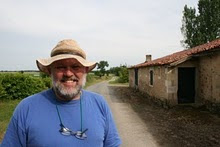
Eric Lewis Colston Higgs
11th January 1925 ~ 6th June 2013


Dad
 
 It is with extreme sadness that I have to inform you that after a relatively short illness, my father died at the end of last week. 
(6th June 2013)
   
This partly explains the recent lack of communication, but there’ll be more about him in due course.
Best wishes
Roger    
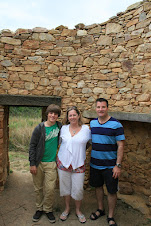
(p.s. I’m the little one!!)


Sunday, June 2, 2013


Today I lunched with Montagu 

part of the series:

Quel monde formidable or loosely translated ~

What a wonderful world!

It was one of those all too rare occasions this year, when we were able to lunch with the door open, as for lunching outside on the terrace; such an occurrence has been even rarer this year.  But, although the world’s weather is indeed part of the “wonderful” world, even though day after day of dreary wet weather stretches that point a little, and somewhat surprisingly the weather forms almost as much of the daily conversations in our part of France as it does in England, this blog post isn’t going to be a rant about the wonderfully awful spring we have had!!

No, but I would like to be able to do a little name dropping and say that lunch was with another nobleman of my acquaintance, a Lord Montagu, Harry to me but sir to the rest of you!  But sadly the Montagu in question despite having the most astonishingly regal air and being indeed a prince amongst others, no you don’t have to say “your Majesty,” is indeed no other that one of the most majestic fliers I have ever had the pleasure and privilege to watch, and all without the harsh drone of a propeller or ear-splitting whistle of a jet engine.  The Montagu in question is no other than a Montagu’s harrier, closely related to the hen harrier, but reputedly the “lightest and most elegant” of the harriers, “with the longest, most swept back wing tips: ideal for riding the warm breezes in Mediterranean summers.”  And, not getting back onto the weather although we reputedly have as many days sunshine each year as the Med they just haven’t arrived this year, they are “scarcer than hen harrier in most places except southern Europe, where they are characteristic of rolling steppes and cereal-growing areas.”

But in these here parts they seem to be relatively common, throughout the summer, and are truly a wonder to behold as they quarter the fields, particularly when recently cut, searching for prey.  Their flight is as I said before majestic; their wings flapping deeply, with wavering glides when their wings form a V shape, (or dihedral to give it its technical name!!)  and with the most astonishing and seemingly impossible twists, turns and dashes to take the small mammals and birds, on which they feed, totally by surprise.  The term poetry in motion must surely have been coined to describe these aerial acrobats, and it is usually the males that catch the eye, as they have much lighter plumage, a pale grey, appearing almost white at times, with distinctive black bands and indeed the first ones I saw, I thought at quick glance, were particularly agile seagulls, surprisingly uncommon around here despite our proximity to the sea.  Here the seagulls don’t seem to have become urban dwellers in the same way as they have in the UK.  The female Montagu harriers are darker, brown on top and a pale yellow-brown underside.  Generally, they can be confused with others, most noticeably the hen harrier or pallid harrier, but apart from subtleties in markings it’s the “elegance and elasticity” that does it for me, both in terms of identification and sheer delight!  And, what a delight to be able to sit in my kitchen having lunch and being entertained so elegantly!

Why Montagu?  Its common name commemorates the British naturalist George Montagu, but its Latin name, Circus pygargus, is certainly very apt as they are just like the most graceful of circus performers and some!!  And, in French; busard cendrĂ©, basically ash harrier, I suppose in reference to the male colouring, well they do say Monsieurs et Madames in France!!

Saturday, March 30, 2013


A murmuration ~ Quel monde formidable!

 This is one of my “regular” country watch articles about “One of the most stunning examples of collective behaviour [in animals]” seen in the world, and we recently had the privilege to view this quite stunning aerial ballet, at close quarters and for some considerable time.

 After our exploits by the sea on New Year’s Eve (see Happy New Year 2013 blog post) where we failed in the darkness to actually find the water, the tide was well out!!  We decided to have a day off from house renovation and take a picnic to the seaside.  It being the depths of winter the picnic was more of a huddle in the car, buffeted by strong winds, whilst overlooking the windswept Anguillon bay, a huge muddy inlet north of La Rochelle and famed for seafood production and a wealth of marine bird life.

 After the picnic, we managed to find a considerable amount of driftwood, blown onto the piled up rocks of the extensive sea defences, by the winter’s gales.  With the car loaded with the makings of an artistic driftwood mirror and some left to burn in our log burner with the promise of a multicoloured flame show due to the salt deposited in the wood, we set off across the flat wide open reclaimed marshes that now border the bay and which must have in autrefois (olden days) have meant that the bay was considerable bigger. As we came around the low cliffs of one of a number of low lying islands, now scattered over the flat marshland like beached boats, there it was in front of us, a huge flock of choreographed starlings, twisting and pirouetting around the wide open sky, balletically moving as one complete, despite there being many thousands of individuals in the cast.  

What we were witnessing and marveling at was “the spectacular display of European starlings (Sturnus vulgaris), the noun for which is a murmuration," scientists Andrew King and David Sumpter said in a 2012 Current Biology report.  Their report continued:

“The mesmerizing act is typically seen at dusk throughout Europe, between November and February. Each evening, shortly before sunset, starlings can be seen performing breathtaking aerial manĹ“uvres, before choosing a place to roost for the night. These range in number from a few hundred to tens of thousands of birds. Murmurations exhibit strong spatial coherence and show extremely synchronized manĹ“uvres, which seem to occur spontaneously, or in response to an approaching threat.

According to Wired magazine, which cited a 2008 report about this animal behavior: "Each starling in a flock is connected to every other. When a flock turns in unison, it’s a phase transition. At the individual level, the rules guiding this are relatively simple. When a neighbour moves, so do you.”

I’m sure that for many of you the word murmuration will be a new word, it certainly is for me, and we found ourselves wondering, as we continued to marvel at the dexterity of this huge flock, as it performed initially in front of the car and subsequently all around us, what’s the trigger for such movements, as every so often the whole flock would land briefly on one of the nearby fields, before quite suddenly and unannounced swirling back into the air like a moving “painting on the sky”, as one appreciative netizen described the amazing bird ballet.  (I guess murmuration was new to many of you, but what about “netizen,” the google spellchecker certainly doesn’t recognise it.  I can only assume that it is a play on the label internet citizen!)

Hence, reference to various pieces of research done into this phenomena and quoted above.  This research is largely inconclusive, and to date no-one has come up with a definitive answer for the behaviour.  However, imagine my surprise when just a week or two later, I was reading an article out of Country Walking magazine, about Icons of England.  The particular part of the larger article was written about George Alagiah, I’m sure known to most of you as a journalist and television news presenter and entitled “A Place in the Country”.  Now, some time later I’m at a loss as to what his Icon of England was as the article has long gone up in smoke, helping to light the woodburner and maybe I’m thinking HE WAS THE ICON!  But in the article he talks about a theory for the art of murmuration. He says that why the starlings “twist and turn in unison, is because the ones on the outside are constantly trying to get to the inside where they feel safer.”  Now in the absence of anything else more convincing, that explanation will do for me!!

Friday, March 29, 2013


It’s Official;

Les anglais sont bougres paresseux

You can translate that one yourselves, suffice to say the last word is lazy and the one preceding it, which in translation would in fact follow it, sounds quite similar to the English if you say it slowly!!

It’s some time ago now, indeed before Christmas which will become apparent later, but I was up at a early hour and sorting out a few things, like emptying the dishwasher and making some bread for lunch, to go with the homemade cheese I had made the day before – impressed or what, but I expect more likely to illicit snide comments like – “Well you’ve got all the time in the world now you’d retired!!”  But, actually it doesn’t particularly feel like that at times, and it’s very true what people seem to always say when they have retired, that they never know how they ever found the time to go to work.

Indeed, having just spent the first two nights in our caravan for over two years, we realise just how busy we have been.  We even felt that we had convinced the neighbours (a supercouple, as in superman, in their late seventies who rarely seem to pause for breath, except when they are shouting at each other, they’re both a little hard of hearing.), with all the initial work in the garden and subsequent house renovation that we were at least trying to keep up with the Joneses!!  Madam had even stopped pointedly quipping, so often, about le petit pause’s or coffee breaks we would have sitting outside in the sunshine between coats of paint or rolls of insulation (although these were as much a case of coming down for air as having a break, but that’s a story told elsewhere!).

Well, there I was flour in my hands when there came a knock on the door, and there was Madam carrying what in this season of goodwill to all men, could only be a Christmas card, complete with English stamp.  Now as the French don’t particularly send Christmas cards, I assumed that it must be a card for us that had been mistakenly put into their letter box and she was giving to its rightful recipient.  But no, their followed a fast piece of one-sided dialogue, which almost had me flummoxed at this hour, but the envelope was clearly marked for our neighbours and somewhere in her rapid delivery was mention of a Nancy and Tony.  Getting rid of the flour from my hands and giving myself time to process the conversation, I realised that the card had come from an English couple who had for many years lived in one of the houses in our hamlet, just behind our house, but who had a couple of year’s previously moved back to the UK.  What I was actually being asked to do was to “translate” the address on the back of the card, written in a very small spidery hand and with an English style address, which like all things English, Madam doesn’t understand and that probably goes for us too!!

With the aid of a magnifying glass that she had kindly thought to bring, I was able to write the address of their new house in deepest Norfolk, with some quite odd sounding names, and we the passed the time of day about whether I had known Tony and Nancy and how she was wanting to sent a reply. 

I then thought I better explain the flour, which I think I failed to mention above was actually in a Tupperware container, not spread over a board and up to my elbows as I manually kneaded the dough.  I was in fact adding the ingredients to the tin before popping it into the machine which would then do the rest.  Initially, Madam was suitably impressed by the fact I told her I was making bread, until I showed her that really a machine was doing all the hard work, at which point she began to look decidedly luddite in her appearance, the look heightened as she turned around and noticed the half emptied dishwasher. 

Collecting herself just in time, she cheerily thanked me for my help and went on her way.  I was only grateful she hadn’t asked after Linda, who I would normally have called to help with the translation should I have needed it.  If she had realised she was still in bed that would have been even more evidence of us being bougres paresseux!!!